Read the Markings: A Field Guide to Every Badge, Code Letter and Ace of Spades 92 Squadron Ever Wore
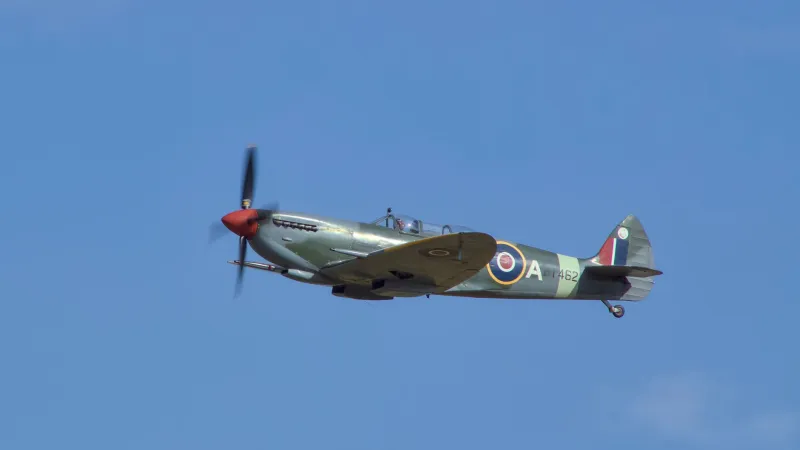
Every squadron leaves its signature in the sky. For 92 Squadron, that signature has taken many forms over more than a century: stencilled code letters on a Bristol F.2B, a heraldic badge approved by the King, and — most famously of all — a playing card painted beside the roundel of a Spitfire. Learning to read these markings is one of the quiet pleasures of RAF heritage, and it transforms a visit to any museum or airshow into something closer to a treasure hunt.
Codes Before Badges: The Early Years
Formed at Stow Maries in 1918, 92 Squadron was born into an RAF still finding its visual identity. Aircraft of the First World War period carried simple squadron numerals and individual flight letters rather than the elaborate schemes that followed. There was no badge, no motto — those refinements came later, when the Air Ministry formalised heraldry in the interwar years.
It was during this period that the squadron's identity began to crystallise. When 92 was re-formed in the 1930s, it inherited a fresh purpose and, eventually, the heraldic recognition that wartime fame would make legendary.
The King's Approval: The Badge and Its Symbolism
The squadron badge, formally granted in the late 1930s, is a masterclass in heraldic economy. Its central device — a hand of playing cards — speaks directly to the reputation the squadron would earn and embrace. The motto that accompanies it carries the same spirit: fortune favours those who take their chance and play their hand well.
To modern eyes the symbolism might seem irreverent for a King's approval, but heraldry has always rewarded character as much as combat. The Air Ministry's heraldic committee recognised that 92's identity was genuine, earned in the messes of Digby and North Weald rather than invented by a designer in London. That authenticity is precisely why the ace of spades endures on commemorative aircraft today.
QJ and the Battle of Britain Alphabet
The markings most visitors ask about are the two-letter code combinations worn on the fuselage during the Second World War. During the Battle of Britain, 92 Squadron's Spitfires carried the code 'QJ', followed by an individual letter identifying each specific aircraft.
These codes were far more than decoration. In the chaos of a mass raid, controllers and fellow pilots identified aircraft by radio callsigns built from those letters. A pilot scrambled from Biggin Hill in September 1940 was, in every practical sense, 'QJ-something' until wheels were down again.
For modellers and researchers, the placement and style of these codes matter. Early war letters were typically painted in the medium grey tones specified by Air Ministry orders, with individual letters changing as aircraft rotated through the squadron. Photographs from the period show subtle variations — some letters slightly oversize, some repositioned after repair — that reveal the hand-painted, human reality behind the regulation.
The Gambler's Mark: Nose Art and Personal Touches
The playing card motif is where regulation ends and personality begins. Spitfire crews, like airmen throughout history, personalised their machines, and 92's crews did so with a flourish that matched their nickname. The ace of spades appeared in various forms — small and discreet on some airframes, bold and prominent on others — applied by ground crew with brush and whatever paint the stores could spare.
Nose art of this kind served a purpose beyond vanity. Airmen have always understood that an aircraft with a name, a symbol or a lucky charm becomes more than a machine. It becomes a comrade. The Gambler Boys' cards were a statement of confidence in the face of odds that every one of them understood all too well.
Reading the Post-War Years
The squadron's markings did not stand still after 1945. Conversion to jets brought new airframes and new conventions, but the heraldic traditions — the badge, the card motif, the sense of a squadron that played its hand boldly — carried through. Enthusiasts studying post-war photographs will notice the badge appearing in more standardised positions as Air Ministry practice evolved, even as individual flair persisted on ground equipment, station signage and squadron memorabilia.
A Spotter's Guide: Identifying Authentic 92 Squadron Aircraft Today
For museum visitors and modellers alike, a few practical pointers:
- Look for the code. Any Spitfire marked 'QJ' with an individual letter is presented in 92 Squadron's Battle of Britain identity. Check the individual letter against published squadron records to match a specific airframe and pilot.
- Find the card. The ace of spades placement varied by airframe and period. Reproductions based on careful photographic research will acknowledge this variation rather than standardising it.
- Check the badge. The heraldic badge with its playing card device should match the officially granted design. Details matter in heraldry, and inaccuracies are the surest sign of a careless reproduction.
- Mind the colours. Battle of Britain Spitfires wore dark green and brown upper surfaces with pale undersides. Schemes that mix eras — jet-age roundels on a 1940 fuselage, for instance — signal a display aircraft rather than a historical representation.
Several collections across Britain have preserved or restored aircraft in 92 Squadron markings, and the squadron's story is also told at the sites of its wartime airfields, where memorials and interpretation boards often feature the badge and codes in detail.
Why the Paint Still Matters
Markings are history written in shorthand. A single fuselage can tell you where an aircraft served, when it was built, who flew it and what its squadron believed about itself. For 92 Squadron, the evolution from plain 1918 numerals to the King's own playing cards traces the journey of a unit that turned a nickname into an identity and an identity into a legacy.
The next time you stand before a Spitfire in a hangar at Duxford, Hendon or anywhere the Gambler Boys' story is told, take a moment with the paintwork. Somewhere on that airframe, if the restorers have done their work faithfully, a small hand of cards is still being played.