Needles, Wax and Winged Hearts: The Records That Played Through 92 Squadron's War
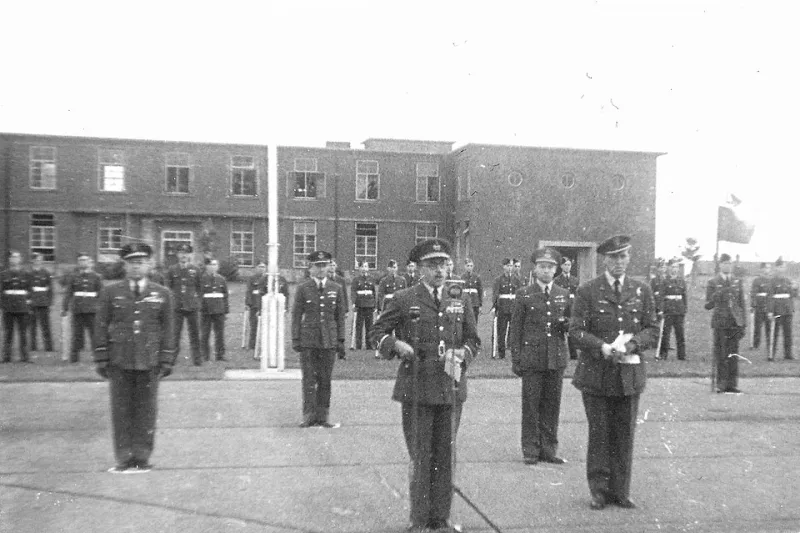
Photo: Scotch Mist, CC BY-SA 4.0, via Wikimedia Commons
Every account of 92 Squadron's war seems to mention the same things: the scramble, the cards, the ace of spades painted proudly on the fuselage. Far less often recorded is what the squadron sounded like when the engines were cold — the crackle of the wireless in the anteroom, the hiss of a shellac record spinning at 78rpm, and the voices of young men singing songs their mothers would not have approved of.
The Wireless in the Dispersal
At Biggin Hill and earlier at Digby and Croydon, the BBC Light Programme was a constant companion. News bulletins were tolerated rather than enjoyed; it was the music that mattered. Vera Lynn's 'We'll Meet Again' — released in 1939 and ubiquitous by the following summer — was, according to one veteran's recollection, played so often in the pilots' mess that a senior NCO reportedly threatened to confiscate the disc. Whether apocryphal or not, the story captures something true: for men who flew against the Luftwaffe with no certainty of return, a song about reunion was not sentimentality. It was a statement of intent.
Dance band music filled the gaps between bulletins. Geraldo and his orchestra, Ambrose, and the BBC Dance Orchestra under Henry Hall were household names, and their recordings drifted across the Kentish countryside from every window of the officers' mess.
The Gramophone and the Portable Wind-Up
Where electricity was scarce, the wind-up portable gramophone reigned — a leather-cased box, often a His Master's Voice or a Columbia, that could be carried out to a dispersal hut and cranked into life between sorties. Records were treasured personal possessions. A single disc of Glenn Miller's 'In the Mood', pressed in America and smuggled across the Atlantic, could make its owner the most popular man in the hut.
Jazz divided opinion then as now. The squadron's younger pilots gravitated towards Miller, Artie Shaw and the swing bands broadcasting from America, while older hands preferred the dance bands or, on quieter evenings, nothing at all but the fire and the rain on the Nissen hut roof.
Songs of Their Own
Not everything the squadron sang came from a pressing plant. Mess dinners at Biggin Hill were rowdy affairs, and the verses sung there were frequently unprintable. RAF drinking songs — many descended from verses inherited from the Royal Flying Corps — circulated by word of mouth, gaining a new couplet with each posting. Songs about the aerodrome, the WAAF, the Station Commander and the vagaries of the meteorological office were composed, amended and forgotten within weeks.
What survives in the archives is only a fragment: a few lines copied into a letter home before the censor's blue pencil, or a verse recorded decades later at a reunion dinner, sung with more affection than accuracy.
A Listener's Tour of the Soundtrack
For those wishing to reconstruct the musical world of 92 Squadron, a representative evening's playlist might read as follows:
- Vera Lynn — 'We'll Meet Again' (1939): The anthem of separation and hope, inescapable on the wireless.
- Glenn Miller — 'In the Mood': The swing era's signature, beloved of the younger pilots.
- Flanagan and Allen — 'Run Rabbit Run': Music hall cheer, Humpty Dumpty-titled defiance against a foe who would find the English sense of humour unbending.
- Anne Shelton — 'I'll Be Seeing You': For the slower dances and the letters home.
- The Regimental and mess songs of the RAF: Unrecorded, unrepeatable, and best left to the imagination.
Sheet music, too, played its part. Pianos were a fixture of RAF messes — often donated, occasionally bought with mess funds — and a pilot who could play 'Chattanooga Choo Choo' by ear was guaranteed an audience.
Where the Music Survives
Original 78rpm pressings remain affordable and abundant at British record fairs, auction houses and online marketplaces, though condition varies enormously. Period-correct portable gramophones appear regularly at militaria fairs from Sandown Park to Stoneleigh. For those preferring to listen rather than collect, archive services such as the British Library's sound collections and various licensed reissue labels have made much of the wartime catalogue newly available.
The Imperial War Museum holds numerous oral history recordings in which former aircrew describe mess life, music and the small rituals of the evening — material that brings the squadron's soundscape back to life more vividly than any photograph.
More Than Background Noise
Music in a fighter squadron was never mere entertainment. It was a pressure valve, a memory of home, a shared language between men who rarely spoke directly about the risks they ran. The same hands that shuffled cards at the mess table wound the gramophone handle the next morning, and the same voice that sang a bawdy verse at midnight might fly a patrol at dawn. To understand 92 Squadron fully, one must listen as well as look — and the songs, it turns out, have lasted remarkably well.