Mill Boys and Miner's Sons: The Ordinary Britain That Sent 92 Squadron Into the Sky
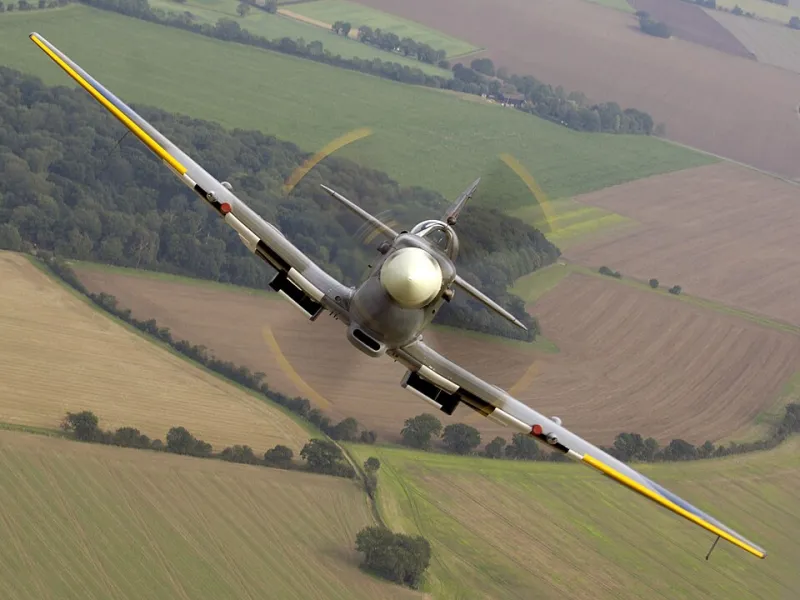
Photo: SAC Scott Lewis, OGL v1.0, via Wikimedia Commons
The photograph is easy to romanticise: a line of young men in Sidcot suits, leaning against a dispersal hut at Biggin Hill, laughing at some joke the camera cannot hear. It is harder — and more honest — to ask where they came from. Not which airfield, not which school, but which street, which kitchen, which pithead or mill gate.
The service records of 92 Squadron's airmen, read alongside the local newspapers of the towns that claimed them, tell a story that sits awkwardly with the gallant-southerner image of the Battle of Britain. This was a squadron drawn from the whole grain of pre-war Britain, and its social mix shaped everything from who volunteered to who was mourned back home.
The Geography of the Recruiting Office
When war came, the RAF's expansion swept through Britain's industrial north and the Welsh coalfields with a speed that surprised the communities themselves. The Bradford Telegraph and Argus and the Western Mail of 1940 are thick with enlistment notices, photographs of local lads in their new blue uniforms, and letters from anxious mothers' committees.
For a mill worker's son in Halifax or a collier's boy from the Rhondda, the Air Force offered something the Army rarely did: a trade, a technical education, and the possibility of becoming a sergeant pilot rather than a commissioned gentleman. The RAF's rank structure, for all its faults, was marginally more permeable than the other services. A clever lad with good eyesight and steady hands could find himself in a cockpit at twenty.
Sergeant pilots formed the backbone of squadrons like 92 during the Battle of Britain, and their origins were overwhelmingly working-class. The commissioned officers — the public schoolboys who gave the service its accent — flew alongside them, shared their dispersal huts, and in the squadron's case, shared the card games that earned 92 its Gambler Boys reputation. The card table, unlike the officers' mess in peacetime, did not much care where a man had been schooled.
Kentish Fields and Welsh Valleys
The squadron's connections to Kent ran deeper than the turf at Biggin Hill. Local farm labourers' sons who joined the ground trades often came from villages within earshot of the airfield, and several pilots had family in the county's orchard country. For these men, a posting to Biggin Hill was, in a strange way, a homecoming — Sunday tea with an aunt in Westerham between sorties.
For the Welshmen and Yorkshiremen, the distance was more than geographic. Letters preserved in local archives record the disorientation of men who had never seen the south of England before their first posting: the chalk landscape, the hop gardens, the odd soft vowels of the Women's Auxiliary Air Force drivers who ferried them to their aircraft. One pilot from a mining valley above Swansea described Kent to his mother as 'a foreign country with better weather.'
Who Flew, Who Died, Who Came Home
The class geography of the squadron is written most starkly in its casualty lists. Statistical studies of RAF losses in 1940 suggest that sergeant pilots — disproportionately drawn from industrial towns — died at rates reflecting their heavy share of operational flying. When a pilot from a Rhondda terrace was lost, his death was recorded in a parish magazine of a few hundred households; when an officer from a notable family fell, the national press took notice.
Those who survived often carried a different burden. Veterans' interviews conducted decades later return repeatedly to a theme of estrangement. The man who had flown Spitfires in battle returned to a mill town where nobody quite knew what to say to him. Several found that only the annual squadron reunions — the same gatherings that sustained the Gambler Boys legend in pubs from Lincolnshire to Kent — gave them a community that understood.
Reading the Records Today
For family historians, the trail is more accessible than many assume. Service records held by the RAF's disclosing authority, combined with digitised local newspapers, parish rolls and the Commonwealth War Graves Commission database, can reconstruct a pilot's journey from mill gate to dispersal hut with remarkable precision. The National Archives' operational record books for 92 Squadron add the operational detail; the local paper adds the human one.
What emerges is a corrective to both mythology and cynicism. The squadron was neither a club for the privileged nor a simple triumph of the common man. It was Britain in miniature — unequal, provincial, improvising — somehow welded into a fighting unit by shared aircraft, shared danger and, yes, shared cards.
The ground they grew from was harder and more varied than the legend admits. That is precisely what makes the legend worth honouring.