Klaxon to Touchdown: A Quarter-Hour in the Life of a Biggin Hill Pilot, September 1940
The Operational Record Book for 92 Squadron records most September 1940 sorties in a single line: 'Squadron scrambled. Enemy fighters crossed coast. No claims.' Behind that bureaucratic sentence lies a quarter of an hour of extraordinary human experience. This piece reconstructs one such scramble — a composite drawn from the squadron's records and pilots' own accounts — and points the heritage traveller towards the Kentish ground beneath it.
Minute Zero: The Klaxon
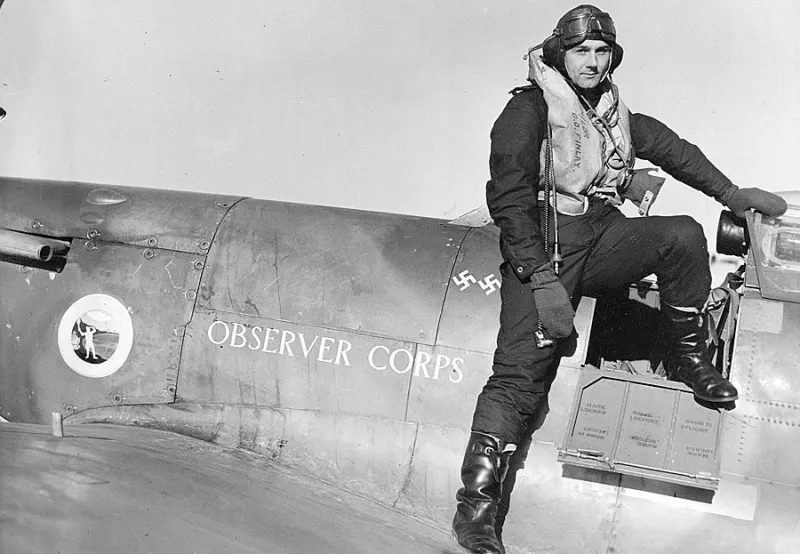
It began, as it always began, with sound. The klaxon at Biggin Hill was engineered to be unforgettable — a rising, mechanical shriek that emptied the dispersal huts in seconds. Pilots dozing in deckchairs, cards abandoned mid-hand (the squadron's Gambler reputation was earned in precisely these interrupted games), sprinted for their machines in fur-lined boots and life jackets already buckled. Sixty seconds from sleep to cockpit was considered respectable.
Minutes One to Three: Starting and Forming
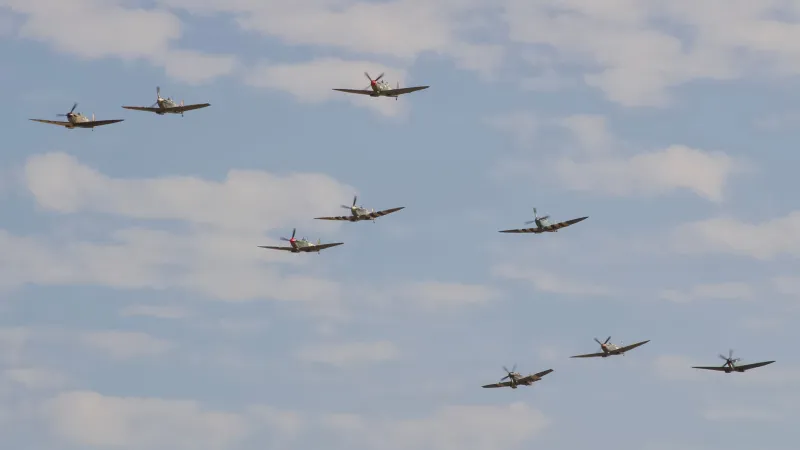
The ground crew had done their part; the Merlin was often already swinging on the external trolley accumulator. Thumbs up, booster coil pressed, and twelve cylinders caught with a cough and a roar. Taxying at Biggin Hill meant dodging bomb craters — by early September the airfield was under near-daily attack. Twelve Spitfires formed up behind the leader, wheels-up by roughly the third minute, throttled hard to gain height towards a rendezvous over the aerodrome.
Minutes Four to Ten: The Climb and the Sighting
From the cockpit, Kent unfolded — the Medway's estuary glittering, the smoke of London drifting on the horizon from the docks fires. The controller's voice crackled through the R/T, vectors given in clipped shorthand. At 15,000 feet the section saw them: a shimmer of crosses above a formation of bombers, contrails on a blue afternoon. The leader's attack was decided in seconds — out of the sun, full throttle, closing at a combined speed approaching 600 mph.
Minutes Eleven to Thirteen: The Combat
Combat, pilots insisted, was nothing like the films. A single stern attack lasted perhaps three seconds — a squeeze of the gun button, the cannon's hammer-blow recoil, a bomber shedding fragments, and then breaking away hard as enemy fighters came down. The ORB might later record laconically: 'F/O Smith damaged one Me 109.' The reality was a pounding heart, hands rigid on the spade grip, and the sudden, shocking silence after.
Minutes Fourteen and Fifteen: Home
Fuel, not courage, set the clock. A Spitfire over Kent at full combat power had minutes to spare, no more. The return was fast and low, wheels down over the boundary, and then — the peculiar anticlimax recorded by nearly every veteran — a cup of tea, a debrief with the intelligence officer, and the cards picked up where they had been dropped.
Standing There Today
The heritage traveller can walk this route. Biggin Hill's St George's Chapel of Remembrance holds the memory of the station's defenders; the Kent Battle of Britain Museum at Hawkinge displays recovered airframe fragments from machines like those the squadron flew; and the viewpoint at Capel-le-Ferne overlooks the Channel these pilots crossed at the edge of their fuel range. Stand there on a clear September afternoon, and the fifteen minutes become strangely easy to imagine.