From the Loft to the Logbook: A Collector's Guide to Verifying Your Family's 92 Squadron Relics
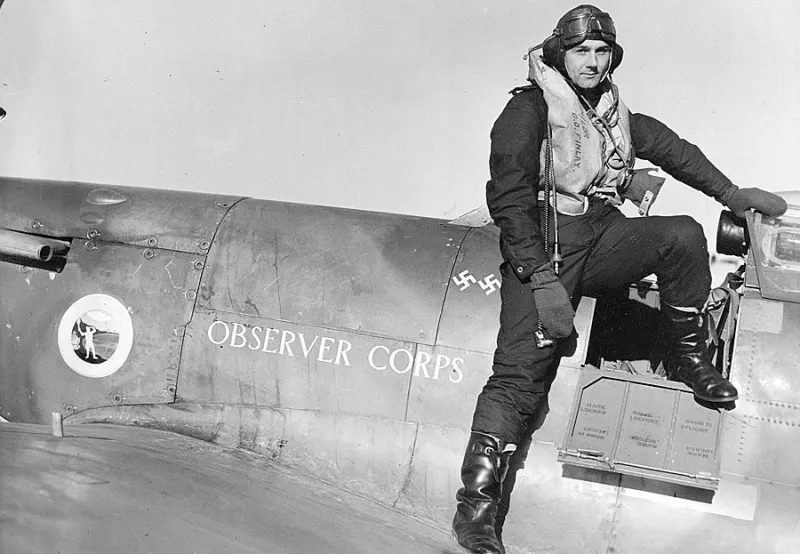
Photo: RAF Official, 1941., Public domain, via Wikimedia Commons
Every year, somewhere in Britain, a loft hatch lifts and a biscuit tin emerges. Inside: a set of wings, a photograph of grinning airmen beside a Spitfire, perhaps a scrap of fabric cut from a fuselage. The family story is vague — a great-uncle who 'was with the Gambler Boys at Biggin Hill', a grandmother who kept everything 'for reasons she never explained'.
For those who want to know whether the tin really holds 92 Squadron history, the path from curiosity to verification is more navigable than most collectors realise. It is also more necessary than ever, because the online marketplace has filled with convincing fakes.
Start With the Code, Not the Story
The single most useful identifier on any genuine 92 Squadron artefact is the squadron's two-letter code, used alongside the individual aircraft letter on Spitfires and later airframes. Photographic prints, logbook entries and personal items marked with these codes can be cross-referenced against published squadron records held at The National Archives in Kew.
Photographs are often the most reliable starting point. Original wartime prints are usually period silver gelatin, often with censor's stamps, photographer's marks or Air Ministry numbering on the reverse. A modern digital reproduction printed on glossy stock and artificially aged is a different proposition entirely — examine the paper, not just the image.
The Growth of the 'Biggin Hill' Souvenir Trade
The fame of the Kent fighter station has made its name a marketing tool. Online auctions now carry an steady stream of items described as 'Biggin Hill squadron' memorabilia: engraved tankards, reproduction patches, signed prints of dubious provenance and, increasingly, fabricated 'named' flying jackets.
Warning signs include:
- Uniform insignia with machine-perfect stitching — period embroidery shows irregularities and age-appropriate wear
- Signatures offered with generic certificates rather than verifiable provenance
- 'Squadron crew rooms' plaques and badges in designs that appear nowhere in period photographs or unit records
- Prices pitched to create urgency — genuine items with documented history command considered prices, not flash-sale bargains
A useful discipline: if a seller cannot state where an item has been since 1945, treat the claim of squadron linkage as unproven.
Documentation Beats Drama
The value of any 92 Squadron relic — financial and historical — rests on its paper trail. Service records (obtainable through the Ministry of Defence for those with next-of-kin status, or via the National Archives for older records), squadron Operational Record Books and unit histories allow a family story to be tested against fact.
If your relative's name appears in the squadron's operational records, even a modest item — a cigarette case, a training manual, a snapshot — acquires genuine significance. If the name does not appear, the item may still be a fine piece of RAF history, but honesty about its origins protects both your family and the wider heritage record.
Where to Turn for a Valuation
For formal valuations, accredited auction houses with dedicated militaria departments offer the safest route, and reputable houses will tell you candidly when an item is not what the family hoped. Independent valuers registered with professional bodies provide a second opinion without the pressure to sell.
But valuation is not the only destination. For items with a verified 92 Squadron connection, a museum may be the better custodian. Regimental and station museums, the RAF Museum and local heritage centres in Kent and Lincolnshire all accept donations or long-term loans, and a museum display reaches more people than a private drawer ever will. Approach the curator first with photographs and documentation rather than arriving with the tin.
When the Answer Is Disappointing
Not every tin contains a provenance. Some contain the ordinary, honourable kit of an ordinary, honourable serviceman — and that, too, is worth keeping. The Gambler legend grew from real men who dealt cards between scrambles; their story is carried as much by the humble objects as by the celebrated ones.
Record what you have, photograph it properly, and write down the family story before it fades. Future researchers — perhaps the grandchildren now lifting loft hatches of their own — will thank you for it.